

BUILT AROUND YOUR DANCING
Dance Physiotherapy in Ivanhoe
For dancers who want to keep dancing. Assessment, injury care and pointe readiness, from a physio who understands Dance.
Dancers need a physio who speaks dance
Being told to rest for six weeks is not a plan. Not when you have an exam in four, a concert in eight, and class three nights a week. Dancers need someone who understands what a fouetté asks of your ankle, why your turnout hurts on one side, and how much load a competition season actually puts through your body. That is what this service is. Expert assessment, honest answers, and a plan that keeps you in the studio wherever we safely can.
Who is it for?
Who we see:
Dancers preparing to go en pointe, or already there and struggling
Dancers with an injury that keeps coming back
Dancers auditioning for a full time or tertiary program
Dancers coming back after time off, injury or a growth spurt
Dancers with pain they have been dancing through
Dancers who want to jump higher, hold their turnout, or find their extensions
Parents who are not sure whether something is normal or worth checking
Every style is welcome. Ballet, contemporary, jazz, tap, hip hop, acro, musical theatre and competition dance.
APPOINTMENTS
Four ways to see us
Your first appointment. We take a full history of your dancing, your training load, your injury history and your goals. Then we assess how you move, test your strength, and work out what is actually driving the problem. You leave with an explanation, a plan and your first exercises.
Follow up care. We reassess, progress your program, treat what needs treating, and adjust your dancing load as you improve. How often you come back depends on what we find, and we will always tell you why.
A full pointe readiness assessment. We look at foot and ankle strength, alignment, lower limb control, trunk stability and where you are at developmentally. You get a clear answer on readiness, a targeted exercise program, and a written summary you can share with your teacher.
A retest. We repeat the same tests, show you what has changed, and progress your program. Useful if you were not ready first time, or if you have started pointe work and want to check things are holding up.


POINTE READINESS
Getting you ready for pointe
Going en pointe puts your whole body weight through your toes. It asks a lot of your feet, your ankles and everything above them, and it asks it while you make it look effortless. A pointe assessment tells you and your teacher whether your body is ready for that yet, and if it is not, exactly what to work on.
What we assess
Foot and ankle strength, particularly calf strength and endurance
Ankle and foot range of motion, and your alignment through demi-pointe
Single leg balance and control
Hip, knee and ankle strength and how they work together
Turnout, and where it is coming from
Trunk and pelvic control
Growth and development stage, and your training history
Your technique through the movements that matter most on pointe
OBJECTIVE TESTING
Numbers, not guesswork
Most dance screenings come down to what the clinician can see and feel. Ours does not stop there.
We use VALD force testing technology, the same systems used in professional sport, to measure what your body is actually producing.
DynaMo dynamometry
We measure the strength of the muscle groups that do the work in dance. Calf, glutes, hip rotators, hamstrings, quads and adductors. Each one gets a number in kilograms, so we know exactly where you sit and where the gap is.
ForceDecks force plates
You jump, hop and land on force plates that measure how much force you produce, how quickly you produce it, and how well you absorb it on landing. It also shows the difference between your left and right side, which is very hard to see with the eye alone.
Why it matters for dancers
Dancers are flexible, controlled and very good at compensating. That combination hides weakness well. Testing finds it before an injury does, and it gives us a number to retest against later so you can see the work paying off.

OUR APPROACH
How we work with dancers.
Three things guide what we do.
We work with your teacher, not around them
With your permission, we send a written summary to your dance teacher after an assessment. Everyone stays on the same page, and your teacher can support the work in class.
Strength is what protects flexibility
Most dancers do not need more range. They need control of the range they already have. Strong dancers hold their positions, land their jumps and last through a season.
Rest is the last option, not the first
We look for what you can keep doing before we take things away. Sometimes a modification, a load change or a technique adjustment is enough. Where full rest is genuinely needed, we will tell you why and give you a timeline.
What we help with
Pointe readiness and pre-pointe preparation
Ankle sprains and ongoing ankle instability
Achilles pain and tendinopathy
Posterior ankle impingement and os trigonum pain
Sesamoiditis, bunions and forefoot pain
Shin pain and bone stress injuries
Patellofemoral pain and knee pain
Snapping hip and hip impingement
Hip flexor and adductor strains
Hamstring strains and proximal hamstring tendinopathy
Lower back pain, including pain with extension work
Turnout limitations and technique related pain
Growth related pain in young dancers, including Sever’s and Osgood-Schlatter
Return to dance after injury or surgery
Audition and tertiary program screening
What you take home
What you leave with
A clear explanation of what is going on and why
Your test results and what the numbers mean
An exercise program built around your results
A written summary for your dance teacher, with your permission
Guidance on what to keep doing, modify or pause in class
A retest date so we can measure the change
Beyond the treatment room
Strength work that supports your dancing
Assessment is the start. What changes things is the work you do between appointments.
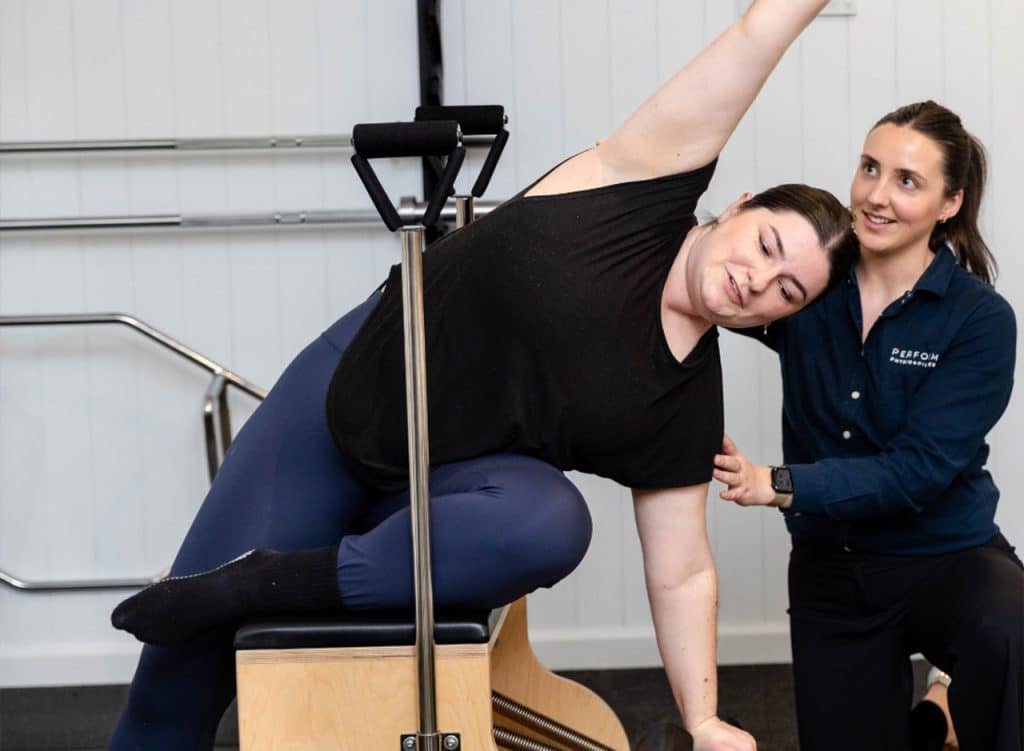
Our Clinical Pilates and exercise programs give dancers a place to build strength, control and stamina under supervision. Reformer and equipment based work suits dancers well, and your program is written by the same physio who assessed you.

Victoria Ching
Physiotherapist
Who you'll see
Victoria Ching is our Associate Physiotherapist and leads dance physiotherapy at Perform. She is a Monash graduate with a background in dance medicine, and an APMA qualified Pilates instructor, which means the strength work she prescribes is built on the same understanding of movement as her assessments.
Victoria sees dancers of all ages and levels at our Ivanhoe clinic. Victoria holds a CSTD Tap Teaching Diploma and completed RAD Advanced 2. She has over 20 years of personal dance training, including jazz, tap, ballet, contemporary and acrobatics, and has performed at Disneyland Anaheim.
Book an appointment
Dance physio appointments and pointe assessments run at our Ivanhoe clinic, 59 Upper Heidelberg Road. Private health rebates apply if you have extras cover with physiotherapy, and you do not need a referral.
What to wear
Something you can move in. Shorts or leggings and a leotard or singlet works well, so we can see how you move. Bare feet, please. Bring your pointe shoes or flat shoes if the appointment is about them, and do not warm up beforehand.
For parents
You are welcome to stay for the whole appointment. Dancers under 18 need a parent or guardian to attend the first appointment.
Need Help Booking?
"*" indicates required fields
Frequently Asked Questions
There is no single right age. Most dancers are assessed somewhere between 11 and 13, but it depends on how long you have trained, how often you dance, and where your body is up to developmentally. That last part is a big reason to be assessed rather than to guess.
We will tell you what is missing and give you a program to work on it. Most dancers who are not ready are not far off, and it is usually strength or control rather than anything you cannot change. We book a retest so you know when to come back.
No. Plenty of the dancers we see have nothing wrong with them. They want to move better, jump higher, or find out what is limiting them before it becomes a problem.
Only if we have to. We start by looking at what you can keep doing. If something genuinely needs to stop for a while, we will tell you why and how long, and give you work to do in the meantime.
With your permission, yes. We send a written summary after assessments so your teacher knows what we found and how to support you in class. Nothing goes to anyone without your consent.
Yes, if your extras cover includes physiotherapy. We process rebates on the spot with HICAPS. Some patients may also be able to access physio under a Medicare care plan arranged by their GP.
No. You can book online or call the clinic.
All of them. Ballet, contemporary, jazz, tap, hip hop, acro, musical theatre and competition dance.
Ivanhoe, at 59 Upper Heidelberg Road, VIC 3079.